

Iraq can pay what it owes abroad. It cannot pay its own staff on time. The Strait of Hormuz was effectively shut within days of the war that began on 28 February, Iraq’s oil income fell 84% in two months, and salaries have been paid late since July.
The crisis is about cash, not debt. The deeper story is about control. Every dollar Iraq earns from oil lands first in an account at the Federal Reserve Bank of New York (New York Fed), and Washington decides whether it moves. Iraq owns its money in law. It does not control it.
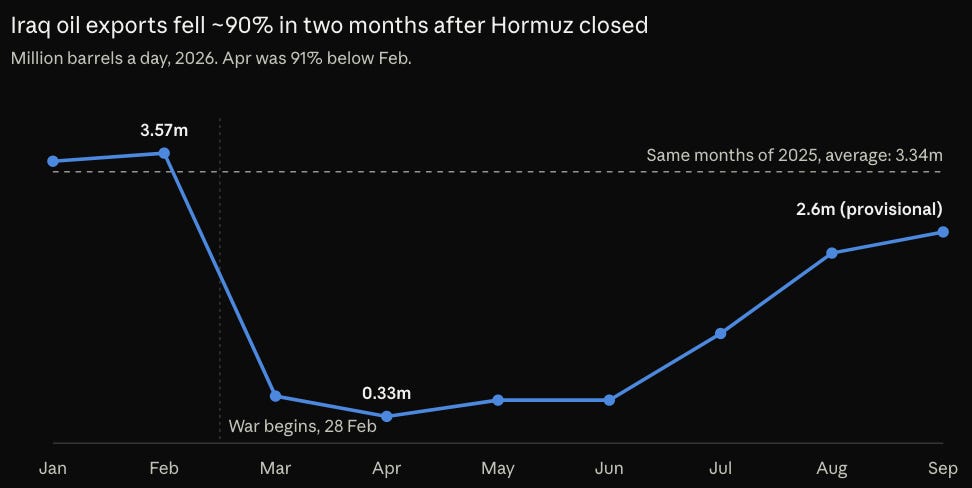
The cash stopped because the oil stopped. Oil pays for ~90% of the Iraqi state, and almost all of it leaves by tanker through Hormuz. Exports fell from ~3.6m barrels a day in February to 0.33m in April. They recovered to ~2.6m in September, but only while tankers are allowed through.
Income fell faster than volume. Buyers now take discounts of up to $37 a barrel below the benchmark, because they carry war-risk: insurance at roughly 3% to 10% of a ship’s value per transit, against 0.1% to 0.25% before the war. No law requires the discount. Buyers can load Saudi crude from the Red Sea or Emirati crude from Fujairah without entering Hormuz. Iraq has no other route and no other income, and the side with fewer alternatives pays.
The bills do not stop, as we know. The state needs ~10tn dinars ($6.7bn) a month, for the salaries and pensions of nearly 8m people. From January to July it spent 65.4tn dinars ($43.6bn) and collected 39.1tn ($26.1bn), a deficit of 26.3tn ($17.5bn). More than 1m state employees had not been paid for July by early August. Health Minister Abdul Hussein Al-Musawi told medical staff: “There is no money.”
The central bank filled the gap. The Finance Ministry sells Treasury bills to the state banks, and the central bank buys them with newly created dinars. It calls this discounting, not printing, which it says its 2004 law forbids. Foreign Minister Fuad Hussein called it printing, putting the sum at 25tn dinars ($16.7bn) in June. If each bill is repaid with a new one, the two are indifferent.
The reserves paid for the rest. The central bank sells dollars to banks so importers can pay for food, medicine and goods, and it sold $31.6bn from January to July while oil dollars dried up. Reserves fell from $102.1bn in February to $80.6bn in July, or ~$58bn excluding gold.
Prime Minister Ali Al-Zaidi told parliament on 8 October that public debt had passed 208tn dinars ($139bn) when he took office. He gave no breakdown, and the debt sits in three piles of different weighting.
The largest is domestic: 109.5tn dinars ($73bn) at the end of July, up 21% this year. Two-thirds is held by the central bank and most of the rest by state banks, so the state largely owes itself. Bonds sold to the public pay 6% to 8.5% a year.
The second is foreign debt that Iraq pays: $10.1bn in April, by the Finance Ministry’s count, of which ~$3bn dates from before 2003. The ministry publishes the total but not a list of lenders. Iraq owes the International Monetary Fund (IMF) nothing in loans; every past programme has been repaid.
The pre-2003 part comes from two settlements. In 2004 the Paris Club, 18 creditor governments including Japan, Russia, France, Germany, the UK and the US, cut $38.9bn of Saddam-era loans by 80%, citing Iraq’s limited capacity to pay rather than whether the debts were legitimate. In 2005 and 2006 private creditors were settled on comparable terms: small claims in cash, large ones swapped into a 5.8% bond at 20 cents per dollar. That bond is Iraq’s only one in the market. About $0.5bn is left, the next ~$183m falls due on 15 January 2027, and it trades at ~99 cents.
The third pile is the one nobody collects: ~$40bn owed mostly to Saudi Arabia, Kuwait and Qatar for loans made in the 1980s. Iraq has paid nothing on it since 2004. The UAE and Algeria wrote off their shares; the others have not. The IMF still lists it as debt in arrears, with relief “requested (but not yet obtained)”.
By the classic test of odious debt, set by Alexander Sack in 1927, this is the strongest modern case. It was borrowed by a dictatorship, spent largely on the war Iraq launched in 1980, and lent by creditors who knew why. No court or tribunal has ever cited the doctrine to cancel a debt, and in 2004 Baghdad and Washington chose not to invoke it. In May 2025 Mazhar Mohammed Saleh, financial adviser to the then Prime Minister, called these “odious debts”.
One debt is closed. Iraq paid $52.4bn of war compensation for the invasion of Kuwait, the last payment on 13 January 2022. The interest once promised on those awards was dropped by the United Nations in 2005 and never paid.
A growing deficit and no immediate law allowing it to borrow, the government turned to the exchange rate. On 7 October the dinar was devalued from ~1,300 to 1,500 per dollar for the Finance Ministry and 1,520 for the public. The street rate moved to ~1,700 on the day.
The reason is the budget. The state is Iraq’s largest seller of dollars, therefore each oil dollar it sells to the central bank now buys 200 more dinars, ~1tn ($0.7bn) more a month. Its domestic debt fell overnight from ~$84bn to $73bn in dollar terms.
The cost unfortunately falls on those paid in dinars. Iraq imports much of its food, medicine and goods, so their prices rise. The devaluation works like a tariff on every import, except that the revenue reaches the state through its dollar sales. State employees, pensioners, savers and holders of fixed dinar bonds pay it, and the poor pay most, because imported food takes the largest share of what they spend.
The choice was political and fiscal. Prime Minister Al-Zaidi named the alternatives he rejected: compulsory savings, salaries every 45 days, or more borrowing. Each shows on a payslip on one day and carries his name. A devaluation leaves the payslip unchanged and spreads the loss over months through prices. Economists call the habit of reading the number rather than what it buys “money illusion”. Prime Minister Al-Zaidi blamed “speculators.” This is the only tool he could use alone. Iraq has no 2026 budget law, borrowing needs an act of parliament, and a devaluation needs only a cabinet decision.
History says the street rate is set on another corner. The December 2020 devaluation brought price rises and protests in Baghdad and southern cities. In February 2023, after the New York Fed tightened its rules on Iraqi banks, the street rate reached ~1,750 and the government cut the official rate to 1,300; weeks later the street rate was still ~1,550. Egypt devalued in steps from 2022 and the gap widened each time, until it floated the pound in March 2024 with $35bn of Emirati investment and an IMF programme expanded to $8bn behind it. The gap closes when dollars arrive, and Iraq’s dollars arrive through Hormuz and New York.
Iraq is not short of savings, and most of them are not in the US. The central bank held $80.6bn at the end of July, ~$58bn excluding gold. About a third sits at the New York Fed. By its own data in early 2026, $10.5bn was at the People’s Bank of China, $10.2bn at the Banque de France and $3.3bn at the Bank of England.
About a quarter of the reserves is gold: 175.6 tonnes, by the World Gold Council’s latest count. At the end of 2023, 97% of it was held abroad and 3% in Baghdad. The central bank does not say where the gold abroad sits. A former director general of the central bank lists the New York Fed, the Bank of England and the Bank for International Settlements among the holders of Iraq’s reserves, gold included.
Spreading the savings protects what Iraq has, but not what it earns. Savings abroad can still be frozen: since 2019 the Bank of England has refused to release Venezuela’s ~31 tonnes of gold, first to the Maduro government and now to its successor.
The account in New York is the centre of the story. Oil buyers pay into the central bank’s account at the New York Fed, and every payment out of it is screened there. The central bank buys those dollars from the Finance Ministry for dinars and sells them on to banks for imports. Only banks that pass US-backed checks may buy those dollars, and each payment they make goes through a foreign bank, such as JP Morgan or Citi, after an audit by Ernst & Young. The rest cannot reach the dollar at all, and their customers turn to the street.
The arrangement began in May 2003, under a United Nations resolution and a US executive order that shielded Iraq’s oil money from creditors. The UN shield ended in 2011 and the US shield in 2014, and since then the accounts have been Iraqi in law. They stayed in New York because oil is sold in dollars, and moving them would risk the dollar access Iraq needs to import.
One thing did not end. The US President renews a national emergency over Iraq every May, most recently on 4 May 2026, and Iraq has no part in it. The notice says the obstacles to Iraq’s reconstruction “continue to pose an unusual and extraordinary threat to the national security and foreign policy of the United States”. It allows the US President act on Iraqi assets without declaring a new emergency.
Washington has used the account as leverage. In January 2020, after Iraq’s parliament voted to expel US troops, it warned that Iraq could lose access to the account, and the troops stayed. Since 2022 more than 30 Iraqi banks have been barred from dollar transactions at US request. In January 2026 it warned that Iraq’s oil revenue could be at risk if armed groups it opposes joined the next government, and President Trump said the US would “no longer help Iraq” if Nouri Al-Maliki returned as Prime Minister. Al-Maliki did not return. From late February to late June it halted shipments of dollar cash until Iraq accepted new controls.
Iraq has room to act. It has moved most of its savings out of the US, but it cannot move the flow. Every new dollar it earns still lands in New York, where Washington decides its fate.
That is a question of sovereignty, not finance. Jean Bodin defined sovereignty in 1576 as “absolute and perpetual power”. Among its marks he listed the power to coin money and set its value. For Bodin, sovereignty cannot be conditional: a power that another can override is not sovereign.
By that test Iraq is not sovereign, and Washington is the reason. Iraq can pass laws, sign treaties, issue dinars and set their value. What gives the dinar its value is the dollars behind it, and Iraq cannot receive or spend those dollars without Washington’s consent.
In law Iraq is still a sovereign state. The Montevideo Convention of 1933 asks only for a population, a territory, a government and the capacity to deal with other states. Money is not mentioned. For the Latin American states at the conference, the core demand was Article 8: “No state has the right to intervene in the internal or external affairs of another.”
Albeit, several of them were under US financial control at the time. The US ran the Dominican Republic’s customs until 1941 and Haiti’s finances until 1947. A monetary test would have defined them out of statehood. In 1933, as now, states that did not control their own money were still called sovereign.
The eurozone is the objection. France and Germany gave up their own currencies and are still called sovereign. The difference is consent: they pooled that power by treaty, their central banks sit on the European Central Bank’s governing council, and they can leave the European Union by law. Iraq has no seat in Washington and no exit from the dollar.
However, moving the account would not change that. Every dollar must settle in New York, regardless of where it is held. Real control means being paid in something other than dollars, or depending less on the dollars Iraq is paid. The steps that lead there run in order of speed.
Iraq can bring home its gold, almost all of which was held abroad at last count. Germany did the same when it moved 674 tonnes from Paris and New York to Frankfurt between 2013 and 2017. Iraq can also ask Washington, in the regular talks between the two governments, to end the 2003 emergency.
Iraq can bring its banks up to international standards, and Washington loses its usual reason for cutting them off from dollars. It can keep moving savings out of dollars and into gold, building on the two-thirds of its reserves already held outside the US.
Iraq should sell part of the oil in other currencies, meaning settled outside the US system, is the only step that frees the flow itself, and the one Washington will punish. Earning money that is not oil is the final and lasting fix: while ~90% of state revenue arrives as one dollar flow, the account controls the state.
Iraq can take the first steps alone. The ones that matter, the flow and the emergency. The account in New York is the most direct leverage Washington holds over Baghdad, and one of its main instruments in the Middle East. Granting Iraq its sovereignty would mean giving up their ace in the region.
The final say on Iraq’s sovereignty sits in Washington, our proof that Iraq does not have it yet. Sovereignty and Freedom are not bought, but won.